Guides, tips, and honest advice from your local bike experts in Byron Center, MI.
🔧
Bike TipsMarch 20266 min read
2026 Spring Tune-Up Checklist: Get Your Bike Ready for the Season
After a long Michigan winter, your bike needs some love. Here's exactly what to check — and what to bring to us — before your first ride of the year.
Read Article →
⛓️
Bike TipsMarch 20265 min read
Chain Stretch: The Low Cost Fix That Can Save You Hundreds of Dollars
A worn chain quietly destroys your cassette and chainring. Here's how to catch it early — and why waiting always costs more.
Read Article →
⚡
Buyer's GuideComing Soon
Electric or Pedal Power? How to Choose the Right Ride in 2026
A straight-talking breakdown of Hiboy, Marin, and Niner to help you find the right fit for your life.
Coming Soon
🏔️
BrandsComing Soon
Trail vs. Gravel vs. Street: Which Category Fits Your Life?
Not all bikes are created equal — and picking the wrong category makes every ride harder.
Coming Soon
🤔
Buyer's GuideComing Soon
5 Questions to Ask Before Buying Your Next Bike
Budget, terrain, effort level, riding frequency — the answers point directly to the right bike for you.
Coming Soon
🛴
ElectricComing Soon
Hiboy E-Scooter Buyer's Guide: Which Model Is Right for You?
From entry-level commuters to high-performance off-road rigs — the Hiboy lineup made simple.
Coming Soon
Buyer's GuideFebruary 20265 min read
Electric or Pedal Power? How to Choose the Right Ride in 2026
The bike market has never been more exciting — or more confusing. Walk into any shop today and you're faced with a dizzying range of options: traditional pedal bikes, electric-assist bikes, and fully electric scooters, each promising to be the right ride for you. So how do you actually choose?
The honest answer is: it depends entirely on what you want to do with it. Let's break it down.
Start With the Question: Why Are You Riding?
Before you look at a single spec sheet, ask yourself one question — what problem are you actually trying to solve? The answer narrows your options dramatically.
Getting to work without arriving sweaty → Electric wins every time
Weekend fitness rides and trail exploration → Traditional pedal bike is your friend
Short urban hops under 10 miles → An e-scooter might be the most practical option
Long gravel rides or mountain trails → You want a purpose-built bike, full stop
The Case for Going Electric: Hiboy
Hiboy has built its reputation on making electric personal vehicles that are genuinely accessible — in price, in ease of use, and in practicality for everyday urban life. Their lineup spans entry-level commuter scooters all the way up to high-performance, all-terrain machines.
The appeal is simple: you don't have to think about it. Charge it overnight, unfold it in the morning, and you're moving. For city commuters who face parking nightmares, sweaty summer rides, or hills that make traditional cycling feel like punishment, a Hiboy e-scooter or e-bike removes all of those friction points at once.
Best for: Urban commuters, short-to-medium distance daily riders, riders who want low-maintenance transportation, and anyone new to cycling who wants an easier entry point.
The Case for Versatile Pedal Power: Marin Bikes
Marin has been building bikes since 1986 in Marin County, California — the birthplace of mountain biking. That heritage shows in their lineup, which covers more ground than almost any other brand: downhill, enduro, trail, XC, gravel, fitness, urban, e-MTB, and even kids' bikes.
What makes Marin stand out is range at accessible price points. You don't have to spend $5,000 to get a well-built, capable bike from them. Models like the Rift Zone bring full-suspension trail performance to riders who want capable without going deep into carbon territory, while the Gestalt and Nicasio series cover gravel and road riders who want to explore beyond pavement.
Best for: Riders who want one bike that can do many things, trail and mountain enthusiasts on a realistic budget, commuters who also want weekend adventure capability.
The Case for Specialized Performance: Niner Bikes
Niner does one thing, and they do it exceptionally well: 29-inch wheel bikes for trail, gravel, and mountain riding. Founded in 2005 in Fort Collins, Colorado, they were pioneers in the 29er movement before it became mainstream, and that focused expertise comes through in every bike they build.
If you're serious about riding — whether that's fast gravel events, technical mountain trails, or bikepacking adventures — Niner's RDO carbon lineup delivers performance that punches well above its price point.
Best for: Committed cyclists who want performance-focused riding, 29er enthusiasts, gravel racers and trail riders, and anyone ready to invest in a bike that grows with their riding.
The Bottom Line
There's no wrong choice here — only the wrong choice for your situation. If your primary goal is frictionless urban transportation, Hiboy solves that problem elegantly and affordably. If you want a versatile, do-everything bike, Marin's broad lineup has an answer at almost every budget. And if you've caught the riding bug and want a bike that matches your growing ambitions on gravel or dirt, Niner builds bikes worth riding for years.
The best move? Be honest about what you'll actually do with it — not what you'd like to do in a perfect world — and pick the category that matches that reality.
Have questions? Stop by the shop — walk-ins welcome Tuesday through Saturday, 11am–4pm. We're happy to talk through your options.
Trail vs. Gravel vs. Street: Which Bike Category Actually Fits Your Life?
One of the most common mistakes first-time bike buyers make is picking a category based on what looks coolest rather than what actually matches how they ride. A hardcore trail bike is miserable for commuting. A slick gravel bike won't survive a proper descent. And an urban scooter has no business on a fire road.
Here's a straight-talking breakdown of who each category is actually for — and which brands are building the best bikes in each one.
Street & Urban: The "Just Get Me There" Category
Urban riding is fundamentally different from trail or gravel riding. You're not looking for the perfect handling arc through a berm — you're looking for reliable, low-fuss transportation that fits your life. That means easy storage, minimal maintenance, and something you're not terrified to lock up outside.
This is Hiboy's home turf. Their electric scooter lineup — ranging from lightweight folders like the S2 series up to more capable commuter models like the KS4 Pro and MAX Pro — is purpose-built for urban environments. Foldable, UL-certified, and available at price points that make them genuinely practical.
For urban riders who specifically want a bike, Marin's Transit and Fitness lines (including their Larkspur E and Fairfax E electric-assist models) offer comfortable, upright riding positions designed for city streets.
You're in this category if: Your rides are mostly under 15 miles, you commute on pavement or bike paths, storage space is limited, and you'd rather not show up to work having broken a sweat.
Gravel: The "I Want to Explore" Category
Gravel riding has exploded in popularity over the last five years, and for good reason: gravel bikes unlock a world of roads and paths that are completely inaccessible to road bikes but don't require the commitment of a full mountain bike setup. Packed dirt, forest service roads, canal paths, country lanes — all fair game.
Niner has become one of the most respected names in gravel riding. Their RLT 9 family — available in aluminum, steel, and full RDO carbon — covers everything from budget-conscious entry-level gravel all the way to race-ready performance. The ORE 9 RDO is their newest and most capable platform, built for long mixed-surface days.
Marin competes strongly here too. Their Gestalt and Gestalt X series, along with the adventure-ready Four Corners, offer gravel capability at prices that don't require financing.
You're in this category if: You want to explore beyond pavement, you like long-distance riding, you're drawn to bikepacking or bike touring, and you want a bike that feels at home on 60% pavement and 40% dirt.
Trail & Mountain: The "I Live for the Ride" Category
Trail and mountain biking is a different world entirely. Rocks, roots, drops, jumps, sustained climbs, and technical descents. The bike needs to handle terrain that would destroy anything else on this list.
Niner's trail lineup — anchored by the RIP 9 RDO and JET 9 RDO — is built around their 29-inch wheel philosophy and CVA suspension design. The CVA system delivers pedaling efficiency without sacrificing descending capability, which is one of the harder engineering problems in trail bike design.
Marin's trail lineup spans from the entry-level Bobcat Trail all the way up to the Rift Zone Carbon and the aggressive Alcatraz enduro machine. Marin also offers e-MTB options (Rift Zone E, Alpine Trail E) for riders who want trail riding with an electric boost on the climbs.
You're in this category if: You ride on actual trails, you want a bike that handles rough terrain with confidence, and the joy of riding is the destination rather than just a means to get somewhere.
What If You're Still Not Sure?
If you genuinely split your time between categories, the most practical answer is usually a capable gravel bike. Bikes like the Niner RLT 9 or Marin Four Corners can handle light trail riding, eat up gravel days, and still be comfortable on your commute home. They're the Swiss Army knife of the bike world.
Stop into the shop and we'll talk through your riding style — no pressure, just honest advice. That's what we're here for.
5 Questions to Ask Before Buying Your Next Bike (And What the Answers Actually Mean)
Buying a bike should be exciting. Too often it becomes overwhelming. There are hundreds of models across dozens of brands, and every spec sheet looks impressive until you're staring at five of them side-by-side trying to figure out what actually matters.
Here are five questions that cut through the noise — and what your answers actually point toward.
Question 1: Do You Want to Break a Sweat — or Just Get There?
This is the most fundamental split in cycling, and it determines more about which bike you need than any other single factor.
If your honest answer is "I just want to get there" — to work, to the store, across town — then electric is almost certainly the right call. A Hiboy e-scooter or electric bike removes the physical exertion from the equation entirely. You're not training; you're commuting. That's a completely valid use case, and electric vehicles handle it better than any traditional bike.
If your answer is "I want the workout" — even occasionally — then you want a traditional pedal bike or an e-bike with a light assist mode you can dial down.
"Just get there" → Hiboy e-scooters, Hiboy e-bikes, Marin electric assist bikes "I want the ride" → Marin trail/gravel/fitness bikes, Niner trail and gravel bikes
Question 2: City Streets or Dirt Trails?
Where you ride determines almost everything about what a bike needs to be. A bike optimized for smooth pavement will actively fight you on dirt, and vice versa.
If the answer is mostly city streets and bike paths, you want something with smooth or semi-smooth tires, a comfortable upright position, and ideally some electric assist to handle hills and headwind. Hiboy's lineup is designed around this use case. So is Marin's fitness and transit line.
If the answer is dirt trails, gravel roads, or actual mountain terrain, you need a bike built for that. Niner and Marin both excel here. And if your answer is "both" — a gravel bike like the Niner RLT 9 or Marin Four Corners is usually the best compromise.
Question 3: What's Your Realistic Budget?
Here's a rough honest map of where each brand sits:
Under $800: Hiboy e-scooters and entry-level e-bikes. Excellent value for urban use.
$800–$2,000: Marin's sweet spot. The Rift Zone, Bobcat Trail, Four Corners — real performance at realistic prices.
$2,000–$3,500: Niner's aluminum and entry carbon models. Serious bikes for serious riders.
$3,500+: Niner's full RDO carbon builds. Performance-first territory.
The honest advice: Buy the best version of what you actually need rather than the entry-level version of what you wish you needed. A well-specced $1,200 Marin will make you happier than a stripped-down $2,200 carbon bike you can't afford to upgrade.
Question 4: How Often Will You Actually Ride?
This one stings a little, but it's worth being honest about. If you're buying a bike to start a new habit, budget accordingly for where you are now, not where you hope to be.
For occasional riders or people just starting out, an accessible bike that removes barriers to riding is more valuable than a high-performance one. Starting accessible and upgrading later is almost always the better strategy.
For committed riders who already ride regularly, investing in quality upfront pays off. Niner's frames are designed to be ridden hard and last a long time — their lifetime frame warranty reflects genuine confidence in the product.
Question 5: Do You Want a Bike That Grows With You?
Niner's frame-first philosophy means their bikes are designed to be upgraded over time. Buy the frame or a lower-spec complete build, then swap components as your skills and budget grow. Their RDO carbon frames in particular are platforms that experienced riders build up deliberately.
Marin's complete bikes are well-specced out of the box and easy to upgrade down the road. Hiboy e-scooters and e-bikes are more closed systems — designed to work, not to be tinkered with. That's a feature if you want it to just work. If you think you'll want to heavily customize your ride, a traditional bike platform gives you more flexibility.
The Short Version
If you've read this far and answered honestly, you probably already know which direction you're leaning. The best bike is the one that matches your real life — your actual commute, your real budget, the trails (or streets) you'll genuinely ride. Don't optimize for the rider you want to be someday. Buy for who you are right now, and the riding itself will take care of the rest.
Ready to talk it through? Stop by the shop — walk-ins welcome Tuesday through Saturday, 11am–4pm. No sales pressure, just honest advice from people who ride.
Spring in Michigan is finally here — which means it's time to drag the bike out of the garage, wipe off the dust, and get it back in shape before your first real ride of the year. Before you even think about replacing your bike, consider this: most bikes that feel "worn out" after winter just need a proper tune-up. A good service can make a three-year-old bike ride like new — for a fraction of what a replacement would cost. Whether your bike sat in a heated space all winter or spent four months in an unheated garage going through freeze-thaw cycles, a proper spring inspection is always money well spent.
🧼
Clean First
🚲
Tires & Wheels
🛑
Brakes
⚙️
Drivetrain
🔩
All the Bolts
✅
Safety Check
1. Give It a Good Clean First
Before you can properly inspect anything, get the grime off. A winter's worth of salt, road debris, and old lubricant makes it impossible to see what you're actually looking at. You don't need fancy products — a bucket of warm soapy water, a soft brush, and a dry rag will do the job for most bikes.
Wipe down the frame, fork, and seatpost — look for any cracks, chips, or scratches while you're at it
Clean the drivetrain (chain, cassette, chainring, derailleur) with a degreaser — old lube turns into grinding paste over time
Dry everything thoroughly before re-lubricating
Quick tip: Don't blast your bike with a high-pressure hose. It forces water into bearings and headsets that are hard to dry out. A gentle rinse or a damp rag is all you need.
Tires are the first thing to check and the most commonly overlooked. Cold temperatures cause rubber to contract and crack over time, and a tire that looked fine in October might be showing sidewall cracks or dry rot by March.
Check tire pressure — tires lose pressure over winter even without a puncture; inflate to the pressure printed on the sidewall
Look for cracking or dry rot — run your fingers along the sidewalls and tread; if you see spiderweb cracks, replace the tire before riding
Check tread wear — if the center of the tread is flat or you can see the casing beneath the rubber, it's time for new rubber
Check for embedded debris — small pieces of glass or wire can sit in a tire for months before finally working through and causing a flat
Spin each wheel and check for wobble — a wheel that's out of true will rub your brake pads unevenly; minor truing is a quick shop fix
3. Test the Brakes
This one is non-negotiable. Brakes that feel fine standing still in your garage can behave completely differently at speed on a wet spring road.
Rim brakes: Check brake pad wear — most pads have a wear line; if pads are at or past it, replace them. Check that pads make full even contact with the rim and that the braking surface isn't worn through
Disc brakes: Check rotor thickness and inspect brake pads through the caliper window. If pads look thin or you hear grinding, bring it in
Both types: Squeeze each lever firmly — it should feel firm and stop well before the handlebar. If it feels spongy, bring it in
When to come see us: Hydraulic brake bleeding makes an enormous difference in feel and safety. If your disc brakes feel mushy or inconsistent, we can sort it out quickly.
This is where most of the "my bike feels terrible" complaints actually come from — and it's almost always a maintenance issue, not a reason to replace the bike. A dry, dirty chain is the single biggest cause of premature wear on your cassette and chainrings. Here's the good news: a chain costs $20–$40 to replace. A cassette costs $60–$150. Catching it early saves you real money and keeps your existing bike running like new.
Measure chain wear — a chain checker tool tells you if the chain has stretched past the replacement threshold. Replace the chain now and your cassette will last significantly longer
Lubricate the chain — after cleaning, apply a fresh coat of chain lube. Wet lube is a good choice for spring riding in Michigan
Check shifting — hesitation, ghost shifts, or chain skipping usually means cable stretch or a limit screw adjustment, both of which are inexpensive shop fixes. Not a reason to buy a new bike
Inspect the derailleur hanger — this small replaceable piece is designed to bend in a crash to protect your derailleur. A new hanger costs a few dollars. If yours is bent, replacing it often fixes shifting problems people have been living with for months
5. Check All the Bolts
Vibration, temperature swings, and winter storage all loosen bolts gradually. A quick pass with the right Allen keys takes ten minutes and can prevent a seatpost slipping mid-ride or a stem coming loose on a descent.
Stem bolts (handlebar clamp and steerer tube clamp)
Seatpost clamp
Saddle rails and saddle clamp
Brake caliper mounting bolts
Bottle cage bolts
Crank arm bolt — this one gets overlooked constantly; a loose crank will destroy the interface quickly
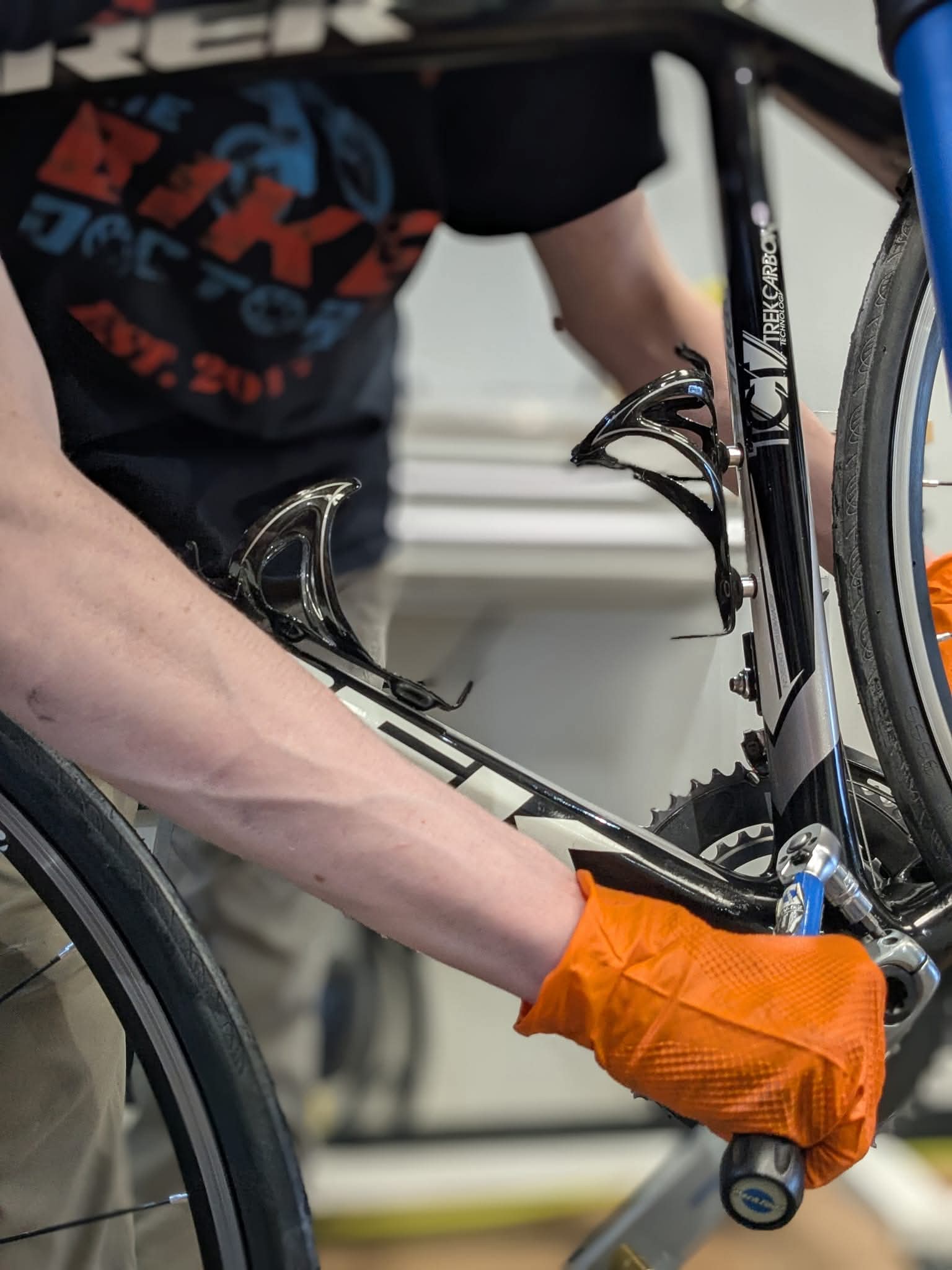
Our tech torquing the crank arm on a Trek carbon road bike — exactly the kind of precision work that keeps your drivetrain healthy season after season.
Important: Carbon components (bars, stems, seatposts, frames) have torque specifications that matter. Over-tightening carbon is how things crack. When in doubt, bring it to us.
6. The Safety Check Before Every Ride
Make this two-minute M-check part of your routine before every ride — not just at the start of the season.
Front Wheel
Axle secured, no wobble
Front Brake
Firm lever feel, pads clear of tire
Stem & Bars
No play, properly aligned
Saddle & Seatpost
Correct height, no side-to-side movement
Rear Brake
Same check as front
Rear Wheel & Tires
Axle secured, inflated, no visible damage
Your Bike Is Worth Fixing
Here's something we say to customers all the time: a well-maintained bike is almost always worth repairing. The parts on a quality bicycle — a Marin frame, a Niner carbon build, even a solid aluminum commuter — are designed to last for decades with proper care. What wears out are the consumables: chains, brake pads, cables, tires. Those are cheap. Replacing them regularly protects the expensive stuff underneath.
A full spring tune-up at our shop typically runs a fraction of what even an entry-level new bike costs — and you walk out riding a bike that fits you, that you already know, that's already broken in the way you like. That's hard to put a price on.
The math is simple: A tune-up that costs $125-400 and makes your bike feel new again is almost always a better investment than a $1000 replacement bike that won't fit or feel as good as the one you already own. We'll always give you an honest assessment of what your bike actually needs — no upselling, no pressure.
When to Bring It to Us
Brake bleeding, wheel truing, headset adjustment, bottom bracket service, derailleur hanger alignment, and anything involving torque specs on carbon components are all jobs we handle every day. If something on your bike doesn't feel right — shifting is rough, brakes feel soft, the bike creaks, or it just doesn't ride the way it used to — bring it in before assuming you need something new. Nine times out of ten, we can fix it for less than you'd expect.
Spring riding in West Michigan is some of the best of the year — the trails are waking up, the roads are quiet, and everything feels fresh. Don't let a bike that just needs some attention sit in the garage another season. Bring it in, let us take a look, and get back out there on a bike that rides the way it's supposed to. See you soon.
Bike TipsMarch 20265 min read
Chain Stretch: The Low Cost Fix That Can Save You Hundreds of Dollars
A worn chain silently destroys the most expensive parts of your drivetrain. Here's what to watch for — and why catching it early always pays off.
There's a maintenance task on your bike that costs almost nothing to stay on top of, takes about 30 seconds to check, and — when ignored — turns into one of the most expensive drivetrain repairs you can face. It's called chain stretch, and it quietly ruins cassettes and chainrings on bikes all over West Michigan every single season.
We see it constantly at the shop: someone brings in a bike because it's skipping gears, jumping under load, or making grinding noises. Nine times out of ten, the root cause is a chain that's been worn past its replacement point for too long. By the time the symptoms show up, the chain isn't the only thing that needs replacing.
What is "chain stretch"? Despite the name, the metal links don't actually stretch. What happens is that the small pins and rollers inside each link wear down gradually, causing the measured distance between links to grow. As the chain elongates, it no longer fits the precisely machined teeth on your cassette and chainrings — and that mismatch is what causes the damage.
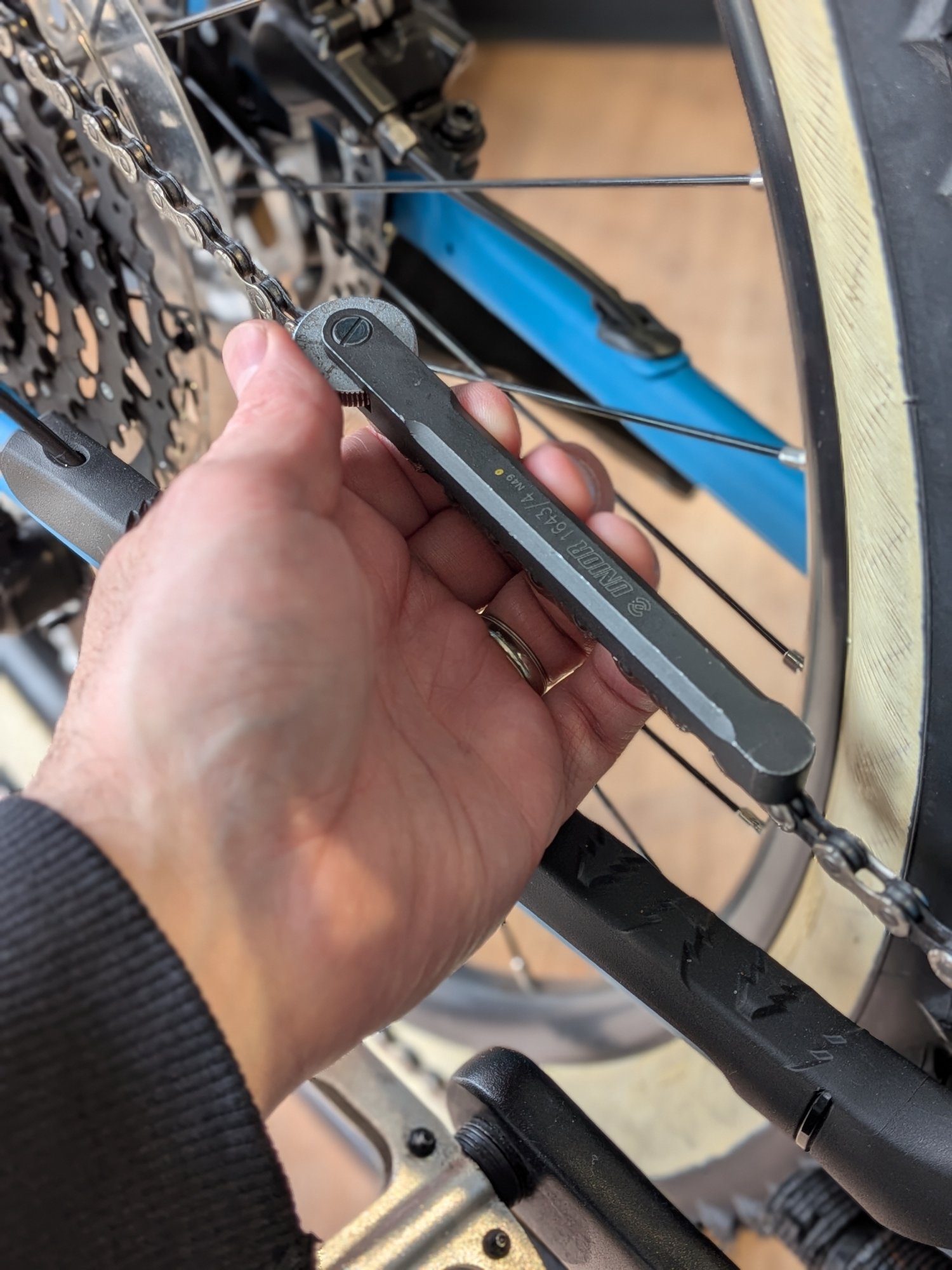
Checking chain wear with a chain wear indicator — a quick, accurate measurement that tells us exactly where your drivetrain stands.
Why It Matters So Much
Chain replacement starts at $50 and up installed — a straightforward, affordable service. Replace it at the right time, and your cassette and chainring — which can each cost hundreds of dollars — will last for years. Wait too long, and the worn chain grinds new grooves into the teeth of those parts. By then, even a new chain won't run smoothly on them, because the teeth have been shaped to fit the worn chain. You have to replace everything.
It's one of the clearest examples in cycling where a small, inexpensive repair done at the right time prevents a large, expensive one later. We never pressure anyone to replace parts they don't need — but chain wear is one of the few places where we'll always be direct with you: replace it now, or pay a lot more later.
$50+
Replace Chain On Time
Chain installed · Cassette & rings survive
Hundreds More
Wait Until It's Skipping
Chain + cassette + chainring replacement
The Warning Signs to Watch For
Chain stretch rarely announces itself all at once. It's a gradual process, and the symptoms creep in slowly — which is exactly why so many riders ignore them for months. Here's what to pay attention to:
⛓️ Chain Skipping
The chain skips or hops over teeth on the cassette, especially under hard pedaling or in a specific gear. Often worse on the most-used gears.
🔊 Metallic Grinding
A subtle (or not-so-subtle) grinding, clicking, or scraping noise while pedaling. Often dismissed as "just a dirty chain" — it may be deeper than that.
🔗 Chain Jumping
The chain suddenly lurches or drops, particularly when climbing, sprinting, or shifting between gears. This is the drivetrain telling you it's past due.
⚙️ Binding Under Load
The pedals feel uneven — smooth then stiff — especially in harder gears or on climbs. The worn chain is catching and releasing on damaged cassette teeth.
Important: These symptoms don't always mean the chain is the only problem. If the chain has been worn for a while, the cassette and chainring may already be damaged. The only way to know for sure is to measure chain wear and inspect the whole drivetrain — which is exactly what we do when you bring a bike in.
How Chain Wear Is Measured
The standard tool is called a chain wear indicator (sometimes called a chain checker). It's an inexpensive gauge that drops into the links of the chain and measures pin-to-pin distance. Most modern chains should be replaced at 0.5% to 0.75% wear, depending on your drivetrain speed. Wait until 1% and the damage to other components is often already done.
You can also do a rough visual check at home: lift the chain off the front chainring at the 3 o'clock position. If the chain pulls away significantly from the teeth — more than half a tooth — it's time. But the gauge is always more accurate, and we check it as part of any service visit.
How Often Should You Replace Your Chain?
There's no single answer — chain life varies widely from rider to rider. The factors that matter most are rider weight, how smoothly you shift gears, the type of riding you do, and the conditions you ride in. Maintenance habits play a big role too: a chain that's regularly cleaned and lubricated will outlast a neglected one by a significant margin. The bottom line is that every rider and every bike is a little different, which is why we check chain wear on every bike that comes through the shop rather than going by a fixed schedule.
⚖️
Rider Weight & Power
Heavier loads and hard efforts accelerate wear on every drivetrain component
⚙️
Shifting Habits
Shifting under load or cross-chaining puts extra stress on the chain and teeth
🌧️
Riding Conditions
Wet, muddy, or gritty conditions wear a chain far faster than dry pavement
🔧
Maintenance & Lube
A well-lubricated, clean chain can last significantly longer than one that's neglected
When in doubt, bring it in. We'll check it in minutes and give you a straight answer on where things stand.
What Happens If You Wait
Quality cassettes for modern drivetrains start at $65 installed and high-end options on performance builds can cost much more than that. Chainrings will add a lot of additional cost to the bill. On a bike with a front derailleur and multiple chainrings, you may be looking at all three needing replacement at the same time.
Beyond the cost, a severely worn drivetrain simply doesn't work well. Shifting becomes unreliable. Climbs become unpredictable. A chain jump at the wrong moment — say, standing up on a steep trail section — can throw you off the bike. This is a safety issue as much as a mechanical one.
Walk-Ins Welcome
Not sure if your chain needs replacing?
Mon–Fri 9am–5pm · Sat 10am–4pm · Byron Center, MI
Bring it in — we'll check it on the spot, no charge.
The bottom line is simple: a chain is a wear item, just like brake pads or tires. It's designed to be replaced. Check it regularly, replace it on time, and the expensive parts underneath it will last for years. Ignore it, and you'll spend five to ten times more fixing what it destroyed. We check chain wear on every bike that comes through the shop, and we'll always tell you the honest truth about what it needs — nothing more, nothing less.